In this guide
Key facts: Slow cookers maintain temperatures between 77°C and 93°C (170–200°F) on their Low and High settings. At these temperatures, collagen in connective tissue fully converts to gelatin in 6–8 hours — the same transformation that makes pressure-cooked braises tender, just achieved over a longer time at lower heat.
How a slow cooker actually works
A slow cooker is simpler than it looks. The ceramic or stoneware insert sits inside a housing with a heating element wrapped around the base and lower walls — not just underneath. That placement matters: heat rises along the sides as well as the bottom, creating a gentler, more even environment than a pot sitting over a burner.
The lid is the other half of the system. As the liquid inside heats up and begins to steam, that moisture has nowhere to go. It condenses on the underside of the lid and drips back in. This closed loop means you lose almost no liquid over an 8-hour cook. By contrast, a braise simmering uncovered on the stovetop can lose 20–30% of its liquid to evaporation in the same time. In a slow cooker, you start with a modest amount of liquid and you finish with nearly the same amount — which is why recipes designed for it use less liquid than traditional braises.
Temperature-wise, the low setting reaches approximately 80–85°C (175–185°F). High reaches 90–95°C (195–205°F). Both are below boiling. The food never bubbles hard — it simmers so gently that the surface barely trembles. That’s intentional. At these temperatures, proteins heat slowly enough to stay tender rather than seizing and toughening, and collagen — the connective tissue in tough cuts — has time to break down into gelatin. That gelatin is what gives a braised chuck roast its silky, pull-apart texture instead of the stringy chew you’d get from cooking it too fast. (Source: McGee, Harold. On Food and Cooking. Scribner, 2004)
None of this happens quickly. The slow cooker trades speed for forgiveness. Give it time, and cheap cuts turn into something exceptional.
High vs low: the real difference
Both settings accomplish the same thing — collagen conversion, tender protein, a rich braising liquid — at different speeds. Low (~80–85°C) takes 8–10 hours for tough braising cuts. High (~90–95°C) does the same job in 4–5 hours.
The temperature gap between the two settings is only about 10°C, but the practical difference in forgiveness is much larger than that number suggests. On low, an extra hour rarely ruins anything. Beef chuck at 9 hours is essentially identical to beef chuck at 10 hours. The meat has already fully converted; holding at low temperature doesn’t degrade it quickly. On high, overcooking by an hour matters more. At 95°C, proteins are closer to the edge where they start to dry out and compact, and there’s less buffer between “done” and “overcooked.”
This gap in forgiveness is most pronounced with lean proteins. Chicken breast has almost no fat and no connective tissue to buffer the effects of excess heat. On high, chicken breast can go from just done to dry and chalky in under an hour. On low, you have a window of maybe 2 hours before it degrades noticeably. Fatty braising cuts — chuck roast, pork shoulder, lamb shoulder, bone-in chicken thighs — are much more forgiving on either setting because their fat and collagen provide insulation against overcooking.
The practical rule: use low when you can. You get a longer window, more tender results for collagen-rich cuts, and far less risk of ruining something while you’re away from the kitchen. Use high when 4–5 hours is all you have, and stick closer to the minimum time in the range.
Timing guide
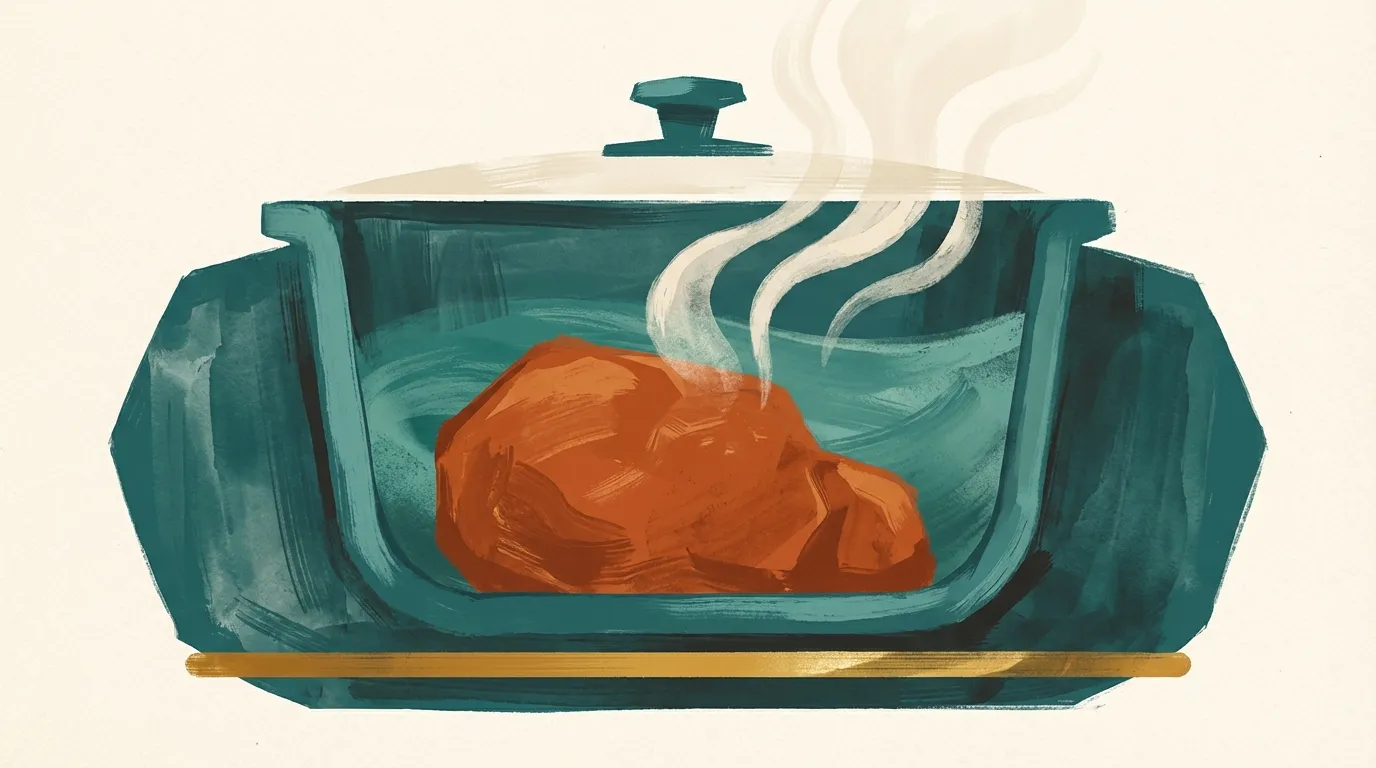
Unlike a pressure cooker, the slow cooker is extremely forgiving at the early end of the time range. The ranges below reflect when food is properly done (early) through comfortably past done (late) — you have a wide window. For proteins, done means fork-tender or pull-apart; they won’t be underdone at the early end of the range.
| Food | Setting | Time | Notes |
|---|---|---|---|
| Beef chuck (whole 1–1.5 kg) | Low | 8–10 hr | Pulls apart; rich braising liquid |
| Beef chuck (whole 1–1.5 kg) | High | 4–5 hr | Check at 4 hr |
| Beef short ribs | Low | 8–10 hr | Falls from bone; skim fat after |
| Chicken thighs (bone-in) | Low | 6–8 hr | Falls from bone; most forgiving cut |
| Chicken thighs (bone-in) | High | 3–4 hr | Check at 3 hr |
| Chicken breast (boneless) | Low | 4–5 hr | Shreds well; dries out past 6 hr |
| Chicken breast (boneless) | High | 2.5–3 hr | Check at 2.5 hr; zero margin for error |
| Pulled pork shoulder (1.5 kg) | Low | 8–10 hr | Fully pull-apart |
| Pulled pork shoulder (1.5 kg) | High | 5–6 hr | |
| Lamb shoulder | Low | 8–10 hr | |
| Chili (canned beans) | Low | 6–8 hr | Add beans in last 2 hr to keep intact |
| Chili (dried beans, soaked) | Low | 8–10 hr | Add at start |
| Lentil soup | Low | 6–8 hr | No soak needed; lentils hold shape |
| Tomato-based sauce | Low | 6–8 hr | Stir once or twice during cooking |
| Carrots / parsnips / potatoes | Low | 6–8 hr | Cut 3–4 cm chunks; add at start |
| Zucchini / peppers / leafy greens | Low | Last 20–30 min | Add late; disintegrate if cooked full time |
| Frozen meat (not recommended) | — | — | Thaw first; slow cooker doesn’t heat fast enough to be safe |
What works well and what doesn’t
Works well:
Cheap fatty braising cuts — chuck roast, short ribs, lamb shoulder, pork butt — are the slow cooker’s strongest use case. No other cooking method lets you load a tough, inexpensive cut in the morning and come home to something genuinely delicious 8 hours later. The combination of low temperature and trapped moisture creates exactly the right conditions for collagen to convert to gelatin over a long period. You can’t rush this in the oven without drying out the outside before the inside is done; the slow cooker solves that by eliminating the temperature gradient entirely.
Pulled meats — chicken thighs, pork shoulder — work exceptionally well because the mechanical process of pulling meat with two forks relies on connective tissue that has fully broken down. Properly cooked pulled pork almost shreds itself.
Chilis, stews, and soups where everything goes in together are where the slow cooker earns its reputation for simplicity. This is genuinely one-pot cooking. Everything shares a braising liquid for 8 hours and the flavors meld in a way that stovetop cooking compressed into 45 minutes can’t replicate.
Dried beans and lentils (presoaked overnight for beans) hydrate and soften beautifully over a long cook, with no monitoring required. Tomato-based sauces develop a depth after 8 hours of slow simmering that a stovetop hour can’t match — the tomato loses its raw acidity, sweetens slightly, and concentrates.
For meal prep, the slow cooker is hard to beat. Cook a large batch of pulled pork or chili on Sunday; it reheats perfectly all week.
Doesn’t work:
Lean proteins like chicken breast and pork tenderloin are technically possible but carry almost zero margin for error. A single hour over the recommended time can turn a chicken breast into something dry and stringy. These cuts are better suited to the oven or stovetop where you can monitor internal temperature closely.
Anything you want browned or crispy has no place in a slow cooker. The Maillard reaction — the browning that creates flavor on seared meat, roasted vegetables, and toasted bread — requires at least 140°C (280°F) and a dry surface. A slow cooker at 85°C with 100% humidity produces the opposite of those conditions. Always sear before, or finish under the broiler after, if color and crust matter.
Pasta and rice added at the start turn to mush. Add pasta in the last 20–30 minutes, or cook it separately and combine at serving.
Delicate fish falls apart over a long cook and the texture becomes unpleasant. Save the slow cooker for meat.
Recipes that depend on evaporation to build a thick sauce will disappoint. Almost no liquid escapes the closed environment. If you need a reduced, glossy sauce, remove the lid for the last 30 minutes on high, or pull out the liquid at the end and reduce it on the stovetop.
How to get better results
The slow cooker is forgiving, but forgiving doesn’t mean foolproof. A few techniques separate a flat, watery braise from something with real depth.
Sear the meat first. This is the single highest-impact step. The slow cooker cannot produce Maillard browning — at 85°C, you’re not even close to the 140°C threshold. Browning in a hot pan before the slow cooker creates hundreds of flavor compounds that the long cook then extracts into the braising liquid. Two minutes per side in a screaming hot pan is enough. The flavor difference after 8 hours is dramatic. Skipping it isn’t dangerous; it’s just a significant downgrade.
Deglaze the searing pan. After the meat comes out, the pan has a layer of brown fond stuck to the bottom. That’s concentrated Maillard flavor. Add a splash of wine, broth, or even water to the hot pan, scrape up every bit with a wooden spoon, and pour it all into the slow cooker. This step costs 30 seconds and adds more flavor than most spices.
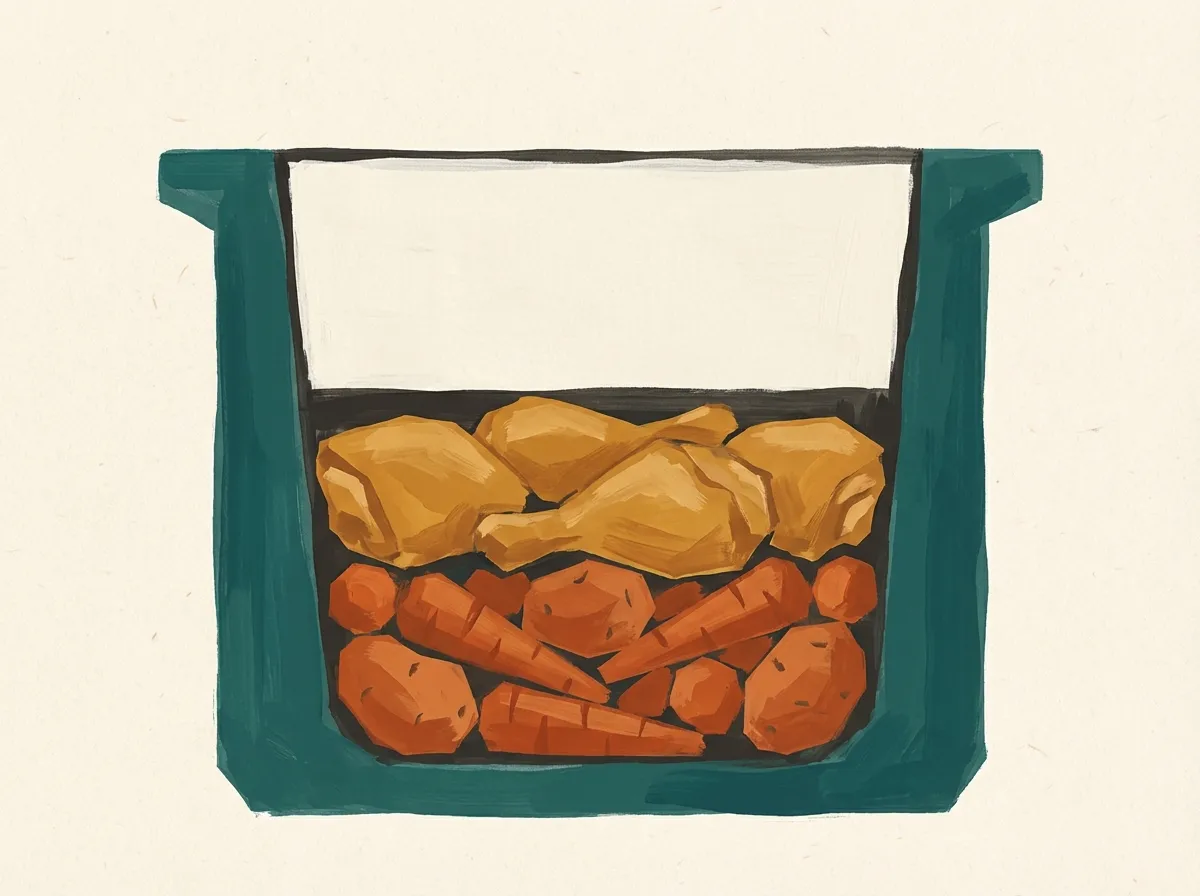
Layer correctly. Dense vegetables — carrots, potatoes, parsnips — go on the bottom. They sit closest to the heating element and take longer to soften. Meat goes on top of the vegetables. Delicate vegetables — zucchini, peppers, leafy greens — go in only for the last 20–30 minutes.
Don’t add too much liquid. The closed-loop evaporation system recirculates almost all moisture. You need enough liquid to cover the bottom by at least 1–2 cm and prevent scorching, but adding 500 ml when 250 ml would do just dilutes your final sauce. Start with less. You can always add more at the end, but you can’t remove it easily.
Add dairy late. Milk, cream, sour cream, and yogurt curdle with prolonged heat. Add them in the last 15–30 minutes. Cream cheese and full-fat coconut milk are more heat-stable and can go in earlier, but even these are better added in the final hour.
Season conservatively at the start. Flavors and salt concentrate as liquid reduces slightly and ingredients release their own moisture throughout the day. A sauce that tasted perfectly seasoned at 8:00 am can taste oversalted by 6:00 pm. Season lightly at the start, then taste and adjust at the end.
Don’t lift the lid. Every time you remove the lid, the slow cooker loses 15–20 minutes of accumulated heat and steam. The closed environment is part of how it works. Resist checking it, especially in the first few hours. (Source: USDA Food Safety and Inspection Service. Slow Cookers and Food Safety. USDA, 2023)
Common mistakes and how to fix them
Watery, flavorless sauce. This is the most common slow cooker complaint. The causes stack: too much liquid, no sear, no deglaze, no aromatics. The fix is to address all four. Use less liquid than you think you need. Sear the meat before it goes in. Deglaze the pan. Start with a proper base — onion, garlic, and other aromatics sautéed until soft before anything else. A slow cooker can’t build flavor on its own; it can only develop what you give it.
Dry, stringy meat. Almost always a sign of overcooking, especially on the high setting with lean cuts. Chicken breast past 6 hours on low or past 3.5 hours on high becomes shoe leather. The fix going forward: use chicken thighs instead of breasts, check closer to the early end of the time range, and default to low whenever you have the time.
Mushy vegetables. Dense vegetables like carrots and potatoes can hold up for a full 8-hour cook, but zucchini, peas, corn, and any leafy green cannot. Added at the start, they dissolve into the sauce by the time the meat is done. Fix: add quick-cooking vegetables in the last 20–30 minutes only. In blended soups where texture doesn’t matter, this is less critical.
Food isn’t cooked after the expected time. A few possible causes: the ceramic insert was very cold when it started (straight from the fridge adds 30–45 minutes to come up to temperature), the lid wasn’t seated properly, or the slow cooker’s heating element is weakening with age. Fix: let the insert sit at room temperature for 15 minutes before starting. Ensure the lid is fully seated. If you suspect the unit is underperforming, check the temperature of the liquid with an instant-read thermometer after 2 hours — it should be well above 70°C (160°F).
Everything tastes flat. No layers of flavor were built before the slow cooker. A braise that starts with unseared meat, no aromatics, and stock poured straight from a carton will taste one-dimensional after 8 hours. Fix: sear, sauté aromatics, deglaze. And at the end, add fresh elements — chopped fresh herbs, a squeeze of lemon juice, a splash of vinegar — that provide brightness against the concentrated, rich base.
Cleaning and maintenance
The ceramic insert is usually dishwasher-safe, but check your manual. Glazed ceramic can develop fine cracks (crazing) over time with repeated dishwasher cycles, which weakens the insert structurally. Hand washing with hot soapy water and a soft sponge takes about the same amount of time and extends the life of the insert significantly.
Never put a cold ceramic insert directly into a hot slow cooker housing, and never pour cold water into a hot insert. Thermal shock — rapid temperature change in ceramic — can crack it. Let the insert cool to room temperature before washing.
The tempered glass lid on most models is dishwasher-safe, but handle it gently. A chipped edge on a tempered glass lid can cause it to shatter unexpectedly.
The outer housing gets a damp cloth wipe only — never submerge it. Grease splatter from cooking finds its way into the gap between the insert and the housing and onto the heating element area. If you smell burning on the next cook, that’s old fat residue. Wipe the exposed interior of the housing with a damp cloth when the unit is completely cold and unplugged.
For stuck-on food inside the ceramic insert, fill it with hot soapy water and let it soak for 20 minutes before washing. Ceramic releases baked-on residue easily once it’s had time to loosen. No scrubbing required and no risk of scratching the surface.
If the slow cooker produces a persistent smell even after cleaning, or if it takes noticeably longer to reach temperature than it used to, the heating element may be at the end of its life. Slow cooker heating elements weaken gradually over years of use. At that point, the unit needs replacing rather than repairing.
Sources
- McGee, Harold. On Food and Cooking: The Science and Lore of the Kitchen. Scribner, 2004.
- USDA Food Safety and Inspection Service. Slow Cookers and Food Safety. USDA, 2023.
- López-Alt, J. Kenji. The Food Lab: Better Home Cooking Through Science. W.W. Norton & Company, 2015.